



The photon and the constant of Planck mathematically
When you are interested in physics you must read “Unbelievable“!
A photon, with enough energy, can transform, split up into a positron and an electron. The assumption that a photon can be described as two charges in oscillation seems acceptable. The Coulomb force between the two charges is:
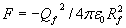
If we try to calculate the energy of the oscillation with F we have to solve a few problems first. Unknown are the size of the charges Qf , the distance Rf at the beginning of the oscillation and at what distance F becomes inactive (so the singularity is avoided).
We assume the maximum distance between the two charges Rf is ¼ λ. The force is then:
This is the total force between both charges. When +Qf moves R to –Qf , then –Qf also moves R to +Qf . The force while both particles moved R will be:

When we integrate F to a distance R=0 a singularity arises. Both the force and energy become infinite. This problem was not solvable before. Now we have an indication for the distance to which F is active: the radius of the neutron Rn or the radius of the proton Rp.
The diameter, the distance between +Qf and –Qf when F=0, when both charges penetrate the point-volume, is twice the radius of the point-volume and therefore approx. twice the calculated radius (2Rn) of the neutron or proton. The energy of the oscillation Wψ will be:
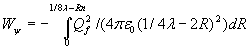

The last formula demonstrates that the arbitrary distance Rf=1/4λ , the maximum distance between the two opposite charges, is of no influence for the energy Wψ of the oscillation because 8Rn<<λ. The oscillation energy will be:
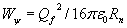
The only unknown factor is Qf. We assume that Qf=Qe/n where n is an arbitrary number:

The charge Qf is replaced Qe/n. The unknown factor is now n. The most straightforward assumption is that  , because the radius of the electron with charge –Qe is Re and the wavelength λ has to be proportional with
  . Substitution gives:

Like electron, proton and neutron the photon has two degrees of freedom to store energy: oscillation and movement. So the total energy of the photon Wf will be equal to 2Wψ.

while the energy of the photon is:
Wf = hν
with H the derived constant and h the constant of Planck. The deviation between h and H is 6%, so the relation is not exact, but fair enough when one considers the radius of the neutron is playing a crucial part. The coincidence that the constant of Planck will derived within a 6% accuracy, when the ether is no more than a wild fantasy, is very unlikely. There are many possible causes to explain the difference, like:
- The mathematical constant π and the natural logarithm e have to arise somewhere. Maybe they arise in the point-volume?
- The electric field of the with speed c moving charges of the photon is forced in a two dimensional circle. Is the three dimensional equation for the electrostatic attraction still completely valid?
- Can the point‑volume be transformed in some way when it becomes a neutron?
The picture the ether showed us so far is that the point‑volume is not rigid.
We assume that the constant of Planck (h) determines the radius of the point‑volume rather than the calculated, and probably deformed, radius of the proton or neutron.
When we use the above derived formula and replace H with the experimental derived value for Planck’s constant h we can calculate Rplanck; the radius of the point‑volume according to the experimental value of h:
The calculated radius of the point‑volume; the Planck‑radius (Rplanck), considering that
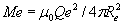 and
and  , becomes:

Next chapter: QM and the Ether: The Derivation of Planck’s Constant


